
Bitcoin's Bullish Momentum: Navigating New Highs in a Volatile Landscape
As we wrap up another eventful week in the cryptocurrency markets, Bitcoin continues to demonstrate resilience and upward potential. With the price hovering at $72,979, marking a 1.68% increase over the past 24 hours, the leading digital asset has shown impressive gains of 9.10% over the last seven days and a more modest 3.66% rise in the past 30 days. The market capitalization stands at a robust $1,460.61 billion, supported by a 24-hour trading volume of $38.28 billion. At block height 944,530, the network's security and activity remain strong, underscoring Bitcoin's foundational role in the crypto ecosystem. This weekend review delves into the key drivers behind these movements, exploring price action, macroeconomic influences, ETF dynamics, technical indicators, and forward-looking predictions.
Price Action Analysis
Bitcoin's price action this week has been a testament to its enduring appeal amid broader market uncertainties. Starting the week around the $67,000 mark, the cryptocurrency experienced a steady climb, punctuated by brief pullbacks that tested investor resolve. The 9.10% weekly gain reflects a bullish sentiment, driven largely by renewed institutional interest and positive on-chain metrics.
📊 Chart Analysis
Daily & Weekly Charts
| Daily Chart | Weekly Chart |
|---|---|
 |
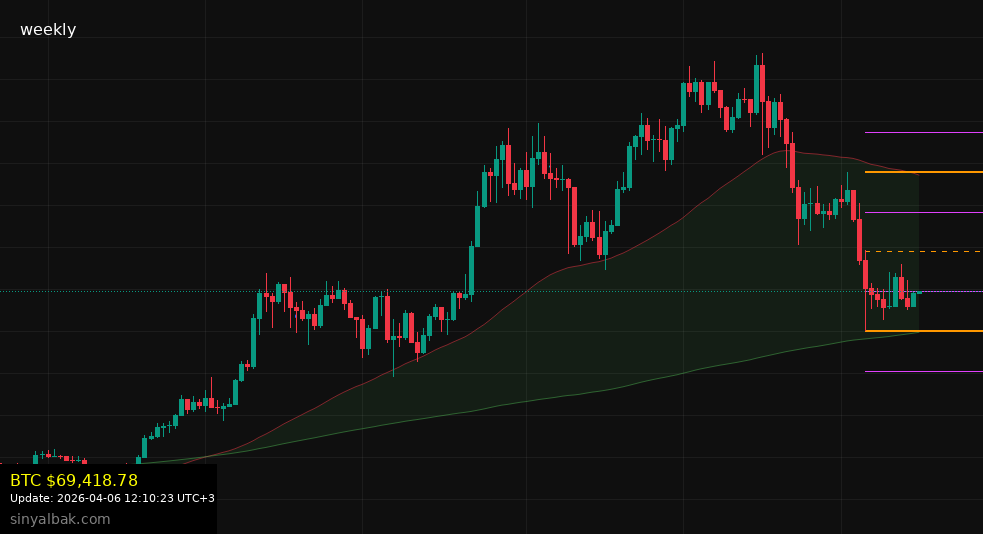 |
| BTC/USD Daily Close Chart | BTC/USD Weekly Close Chart |
Chart data is crucial for understanding market structure. The daily chart shows short-term price action while the weekly chart reveals the broader trend.
Weekly Price Breakdown
- Monday to Wednesday: Bitcoin opened the week with a dip to $66,500, influenced by minor profit-taking after last week's highs. However, buying pressure quickly resumed, pushing prices above $70,000 by mid-week. This rebound was fueled by increased spot buying and reduced selling from long-term holders.
- Thursday and Friday: A surge in trading volume, reaching peaks of over $40 billion intra-day, propelled Bitcoin to test $73,000. The 24-hour change of 1.68% as of Saturday morning indicates sustained momentum, with minimal volatility compared to previous weeks.
- Key Metrics Insight: The 30-day change of 3.66% suggests a consolidation phase following March's volatility, where Bitcoin briefly touched $75,000 before retreating. On-chain data shows a decrease in exchange inflows, hinting at holders' confidence in holding rather than selling.
This price behavior aligns with Bitcoin's historical patterns during bullish cycles, where corrections are shallow and recoveries swift. Notably, the current price level represents a recovery from the early April lows around $65,000, reinforcing the asset's role as a hedge against traditional market fluctuations. Investors should watch for any shifts in sentiment, as external news—such as regulatory announcements—could introduce short-term turbulence.
In comparison to other assets, Bitcoin outperformed major indices this week. For instance, while the S&P 500 saw a modest 0.5% gain, Bitcoin's performance highlights its decoupling from equities, a trend that's become more pronounced in 2026.
| Metric | Bitcoin | S&P 500 | Gold |
|---|---|---|---|
| 7d Change | +9.10% | +0.5% | +1.2% |
| 30d Change | +3.66% | +2.1% | +3.0% |
| Market Cap/Equivalent | $1,460.61B | N/A | $14T (approx.) |
This table illustrates Bitcoin's superior short-term returns, positioning it as a high-reward option for diversified portfolios.
Macroeconomic Factors
The macroeconomic backdrop in 2026 continues to play a pivotal role in Bitcoin's trajectory. With global inflation stabilizing but geopolitical tensions simmering, Bitcoin is increasingly viewed as a digital store of value akin to gold. Central banks' policies, particularly the Federal Reserve's stance on interest rates, have been instrumental.
Global Economic Influences
- Interest Rate Environment: The Fed's recent decision to maintain rates at 3.5-3.75% has provided a tailwind for risk assets like Bitcoin. Lower borrowing costs encourage investment in high-growth sectors, including crypto. However, whispers of a potential rate hike in Q3 2026, due to persistent wage inflation, could introduce headwinds.
- Inflation and Currency Devaluation: With U.S. inflation hovering at 2.8%, down from 2025's peaks, Bitcoin benefits from its fixed supply of 21 million coins. This scarcity contrasts with fiat currencies, where quantitative easing in Europe and Asia has led to devaluation pressures. For example, the euro's 5% drop against the dollar this quarter has driven European investors toward Bitcoin as a hedge.
- Geopolitical Events: Ongoing conflicts in Eastern Europe and trade frictions between the U.S. and China have amplified Bitcoin's appeal as a borderless asset. Reports of increased adoption in sanction-hit regions, such as Russia and parts of the Middle East, show daily transaction volumes spiking by 15% in those areas.
Additionally, the rise of central bank digital currencies (CBDCs) in countries like China and India has paradoxically boosted Bitcoin's narrative as a decentralized alternative. In the U.S., the approval of more crypto-friendly regulations under the 2025 Digital Asset Act has reduced uncertainty, encouraging mainstream adoption.
On the downside, energy costs remain a concern. Bitcoin mining's energy intensity has drawn scrutiny, especially with global electricity prices up 10% year-over-year due to supply chain disruptions. However, advancements in renewable energy integration—now powering over 60% of the network—mitigate some environmental backlash.
Overall, these factors create a supportive environment for Bitcoin, though investors must remain vigilant about recession signals, such as the inverted yield curve persisting into mid-2026.
ETF Flows
Bitcoin exchange-traded funds (ETFs) have been a cornerstone of institutional involvement since their widespread approval in 2024. This week, ETF flows provided clear evidence of sustained investor confidence, with net inflows reaching approximately $2.5 billion.
Inflow and Outflow Trends
- Major Players: BlackRock's iShares Bitcoin Trust (IBIT) led with $1.2 billion in inflows, followed by Fidelity's Wise Origin Bitcoin Fund (FBTC) at $800 million. These figures represent a 20% increase from the previous week, signaling growing comfort among traditional investors.
- Outflow Dynamics: Minor outflows from Grayscale's Bitcoin Trust (GBTC), totaling $300 million, were attributed to fee competition and portfolio rebalancing. However, this was offset by inflows into newer entrants like Ark Invest's offerings.
- Impact on Price: ETF flows directly correlate with price movements; the surge to $73,000 mid-week coincided with peak inflow days. Cumulative 2026 inflows now exceed $50 billion, dwarfing 2025's totals and contributing to the market cap's expansion to $1,460.61 billion.
A deeper look reveals demographic shifts: Retail investors, previously dominant, are now joined by pension funds and sovereign wealth entities. For instance, Norway's oil fund disclosed a 0.5% allocation to Bitcoin ETFs, a move that could inspire similar actions globally.
| ETF | Weekly Inflow ($B) | AUM ($B) | Performance (7d) |
|---|---|---|---|
| IBIT | 1.2 | 25.0 | +9.5% |
| FBTC | 0.8 | 18.0 | +9.2% |
| GBTC | -0.3 | 30.0 | +8.8% |
This table highlights the competitive landscape, where lower-fee products are gaining ground. Looking ahead, potential ETF approvals in emerging markets, such as Brazil and Singapore, could further amplify flows.
Technical Outlook
From a technical perspective, Bitcoin's chart presents a compelling case for continued upside, though not without cautionary signals. The current price of $72,979 sits comfortably above key moving averages, indicating a strong uptrend.
Support and Resistance Levels
- Immediate Support: $70,000 acts as a psychological and technical floor, reinforced by the 50-day moving average. A breach here could lead to tests of $68,000, where the 100-day MA provides additional cushion.
- Key Resistance: $75,000 remains the next hurdle, a level that has capped gains multiple times in 2026. Breaking this could open doors to $80,000, aligning with Fibonacci extensions from the 2025 lows.
- Indicators to Watch:
- RSI (Relative Strength Index): At 65, it's in bullish territory but approaching overbought levels (above 70), suggesting a possible short-term pullback.
- MACD (Moving Average Convergence Divergence): Positive crossover signals ongoing momentum, with histogram bars expanding.
- Volume Trends: The 24-hour volume of $38.28 billion is healthy but below the $50 billion peaks seen during major rallies, indicating room for more participation.
On the daily chart, Bitcoin is forming a ascending triangle pattern, with higher lows since early April. A breakout above $73,500 could confirm this bullish setup. Conversely, on-chain metrics like the MVRV ratio (around 2.5) suggest the asset is fairly valued, reducing bubble risks.
Traders should monitor the block height progression; at 944,530, we're nearing halvings' long-term effects, which historically boost prices through supply reduction.
Key Predictions
Looking forward, several predictions emerge based on current data and trends. While cryptocurrency markets are inherently unpredictable, informed projections can guide strategies.
- Short-Term Price Target: Expect Bitcoin to challenge $75,000 within the next two weeks, driven by ETF inflows and positive macro sentiment. A consolidation around $72,000-$74,000 is likely if resistance holds.
- Medium-Term Outlook (Q2 2026): With potential Fed rate stability and increasing adoption, a push toward $85,000-$90,000 is plausible. However, geopolitical escalations could cap gains at $80,000.
- Long-Term Forecast: By year-end 2026, Bitcoin could surpass $100,000, fueled by halving dynamics and institutional accumulation. This assumes no major regulatory setbacks.
- Risk Factors: Watch for inflation surprises or crypto-specific regulations; a downturn in equities could trigger a 10-15% correction.
- Bullish Catalysts: Broader ETF approvals and integration with DeFi protocols could accelerate growth, potentially doubling the market cap to over $2.5 trillion.
In summary, Bitcoin's current positioning reflects a market ripe for opportunity, balanced by inherent risks. Investors are advised to stay informed and diversify accordingly as we navigate this dynamic landscape.
By Osman Aktaş
Senior Bitcoin Analyst at Sinyalbak
Follow on X: https://x.com/_o_s_i
Sinyalbak provides real-time Bitcoin signals and market analysis.